
I think marketing has made me allergic to the word "strategy"
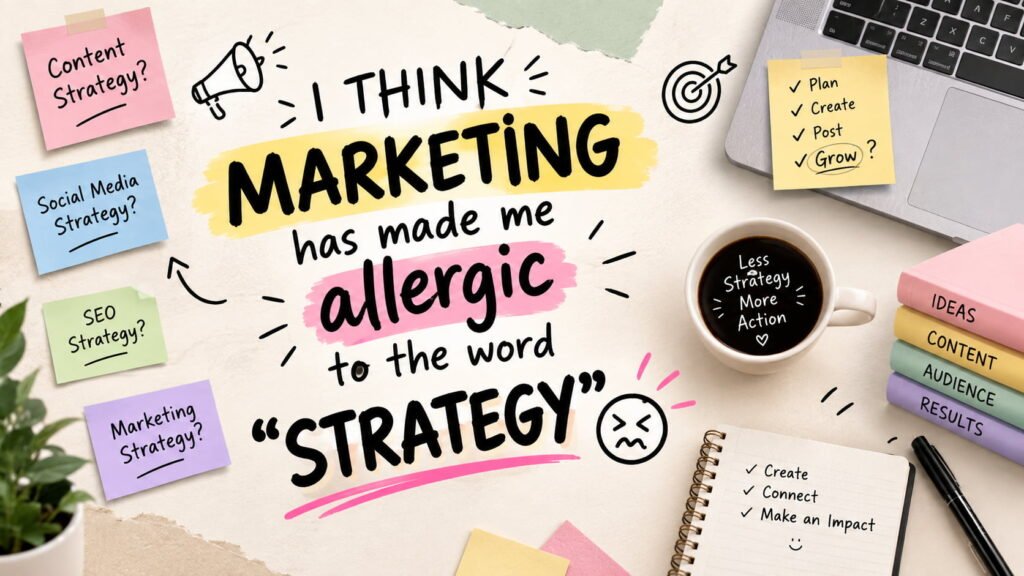
I Think Marketing Has Made Me Allergic to the Word “Strategy”
If you work in marketing, there’s a good chance you’ve heard the word “strategy” so many times that it has started to lose its meaning.
“Let’s build a strategy.”
“We need a strong content strategy.”
“What’s your marketing strategy?”
“Without a strategy, you’re just posting.”
At some point, you start wondering: Can we just make the post?
I’m not saying strategy is useless. It absolutely isn’t. In fact, good marketing needs direction. But somewhere along the way, the word strategy became one of those impressive-sounding words that gets added to almost every marketing conversation—even when nobody really explains what it actually means.
And honestly, I think marketing has made me a little allergic to it.
When Everything Became a Strategy
Marketing has a funny habit of turning simple things into complicated terminology.
You want to post a reel?
That’s a content strategy.
You want more people to find your website?
That’s an SEO strategy.
You want to send an email?
Apparently, you need an email marketing strategy.
You want to post consistently on Instagram?
Congratulations, you now have a social media strategy.
The problem isn’t the word itself. The problem is that sometimes “strategy” becomes a substitute for actually doing the work.
A beautifully designed strategy document doesn’t automatically bring customers.
A 30-page marketing plan doesn’t guarantee a viral post.
And a presentation filled with arrows, funnels and buzzwords isn’t necessarily going to make a business grow.
Sometimes, you simply need to understand the customer, know what you’re trying to achieve, make something useful, put it out there and see what happens.
Then improve it.
Strategy Shouldn’t Feel Like Homework
I’ve noticed that marketing becomes unnecessarily intimidating when strategy is treated like a complicated academic subject.
There are frameworks.
There are funnels.
There are customer personas.
There are competitor analyses.
There are content pillars.
There are KPIs.
There are calendars.
And yes, these things can be useful.
But strategy doesn’t have to begin with a giant spreadsheet.
Sometimes it starts with a very simple question:
“What are we actually trying to achieve?”
Maybe a small business wants more enquiries.
Maybe a creator wants to build an audience.
Maybe a clothing brand wants people to discover its new collection.
Maybe a freelancer simply wants three good clients this month.
Those goals are different. So the approach should be different too.
That’s strategy in its simplest form: knowing where you’re going before deciding how to get there.
No fancy presentation required.
The Best Strategies Are Often Invisible
Here’s something I’ve started to appreciate about good marketing:
When a strategy is working really well, you might not even notice it.
You see a funny reel and share it with your friend.
You read a brand’s caption and suddenly understand what they sell.
You search for something on Google and find exactly the answer you needed.
You receive an email at the perfect moment and decide to check out a product.
None of these experiences scream, “LOOK! THIS IS OUR STRATEGY!”
They just feel natural.
That’s probably what good marketing should feel like.
The customer shouldn’t have to see all the planning happening behind the scenes. They should simply experience something that makes sense to them.
Stop Creating Strategies Just to Have a Strategy
This is probably where my allergy really comes from.
Sometimes marketers create strategies because they’re expected to create a strategy—not because the business actually needs another document.
I’ve seen how easy it is to spend hours planning what to post next week, only to realize that the content itself isn’t saying anything interesting.
You can plan twelve posts.
You can create five content pillars.
You can colour-code your calendar.
You can schedule everything.
But if you haven’t understood why someone should care, all that planning doesn’t mean much.
Marketing isn’t a competition to see who can create the most complicated plan.
It’s about connecting the right message with the right person at the right time.
Maybe We Need Less “Strategy” and More Curiosity
One thing I think marketers sometimes forget is to simply be curious.
Why did that post perform better?
Why did nobody click this link?
Why are people asking the same question again and again?
Why are customers choosing the competitor?
Why did a simple video get more attention than the polished campaign?
These questions can teach you more than blindly following a marketing template.
The market changes.
People change.
Platforms change.
Trends change.
What worked six months ago might completely flop today.
So instead of treating strategy as something we create once and follow forever, maybe we should treat it as something we continuously adjust.
Test.
Learn.
Change.
Repeat.
That feels much more realistic.
So, Do We Really Need Strategy?
Yes.
Just not the kind of strategy that exists only inside a presentation.
A useful strategy should make decisions easier.
It should tell you what to focus on, what to ignore, who you’re talking to and what you want people to do next.
It should give you direction without killing creativity.
And most importantly, it should eventually lead to action.
Because marketing doesn’t happen inside a strategy document.
It happens when the post goes live.
When someone clicks.
When someone comments.
When a customer sends an enquiry.
When somebody remembers your brand.
When someone finally says, “This is exactly what I was looking for.”
So yes, I might still be allergic to the word “strategy.”
But maybe I don’t actually hate strategy.
Maybe I just hate strategy for the sake of strategy.
Give me a clear goal, a good idea, an audience worth listening to and enough freedom to experiment.
Then we can call it whatever we want.
Even strategy.